Foundation Paper III – Judicial Process | LL.M. Comprehensive Course
Categories: Legal, LLM
Wishlist Share
Share Course
Page Link
Share On Social Media

About Course

FOUNDATION PAPER III – JUDICIAL PROCESS 

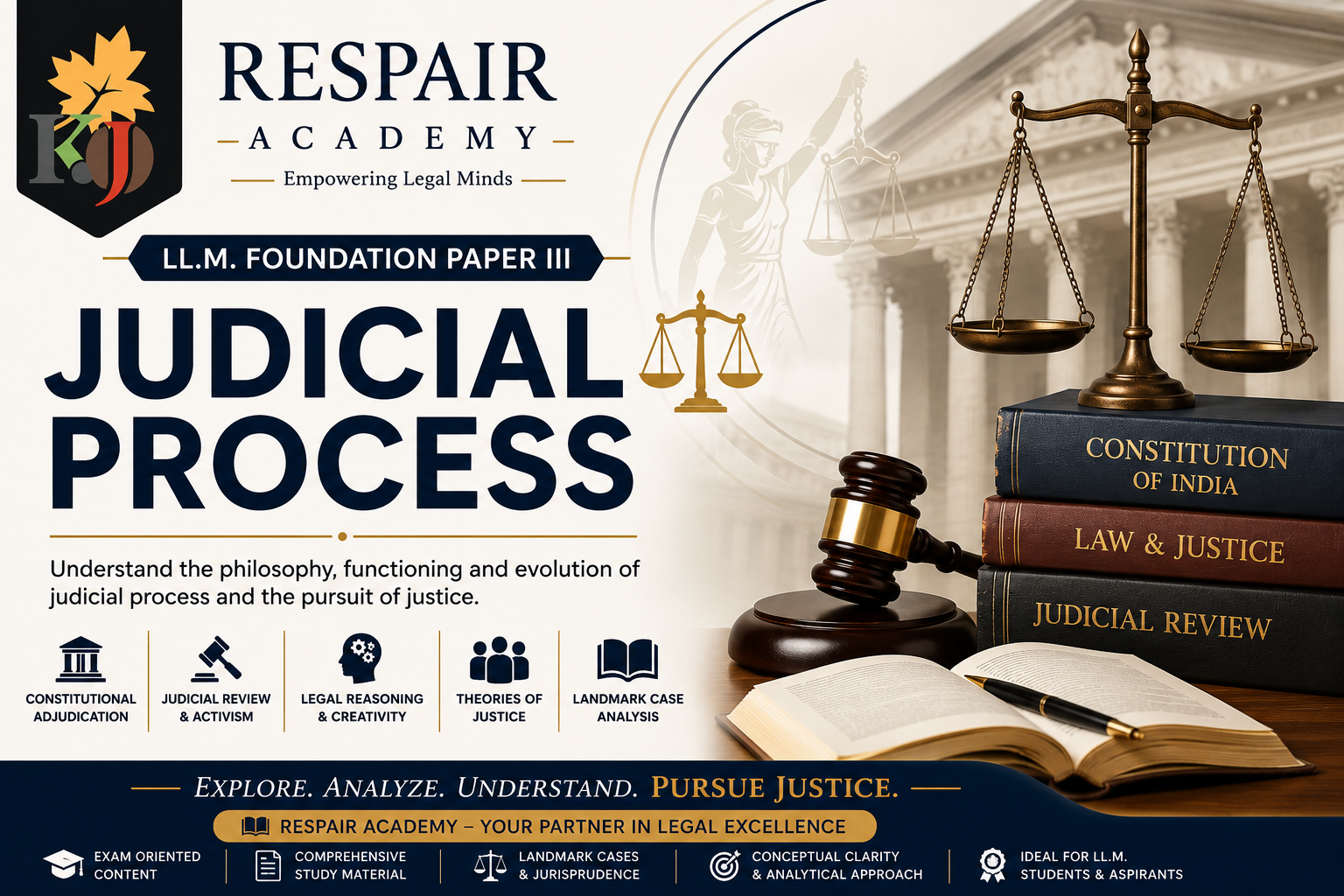
Build a deep understanding of the philosophy, functioning, and evolution of the judicial system through this comprehensive LL.M. Foundation Paper III course by Respair Academy.

This course is specially designed for LL.M. students, judiciary aspirants, legal researchers, and law scholars who want conceptual clarity along with examination-oriented preparation.

The course systematically explains the nature of judicial process, judicial creativity, constitutional adjudication, judicial activism, theories of justice, and the evolving role of the Indian judiciary with reference to landmark Supreme Court decisions and important jurisprudential theories.

What Will You Learn?

  • Module I – Nature of Judicial Process
  • Judicial process as an instrument of social ordering
  • Judicial creativity and law-making
  • Legal reasoning and growth of law
  • Common law model and precedent
  • Stability vs change in law
  • Tools and techniques of judicial creativity
  • Judicial reasoning under codified legal systems
  • Module II – Judicial Process in Constitutional Adjudication
  • Concept and scope of judicial review
  • Constitutional interpretation theories
  • Judicial policy-making
  • Judicial activism and constitutional creativity
  • Accountability in judicial law-making
  • Constitutional adjudication techniques
  • Module III – Judicial Process in India
  • Indian perspective on judicial review
  • Independence of judiciary
  • Political dimensions of judicial process
  • Judicial activism of the Supreme Court of India
  • Constitutional goals and transformative constitutionalism
  • Institutional limitations and judicial accountability
  • Module IV – Concept of Justice
  • Dharma and justice in Indian philosophy
  • Ancient Indian legal thought
  • Western theories of justice
  • Liberal contractual theories
  • Utilitarian theories of justice
  • Moral theories of justice
  • Module V – Relations Between Law and Justice
  • Equivalence theories
  • Dependency theories
  • Independence theories
  • Relationship between law and justice under the Indian Constitution
  • Supreme Court case analysis through theories of justice

Course Content

CLASS NOTES

  • CLASS 1 AND CLASS 2 PDF

Session recording